

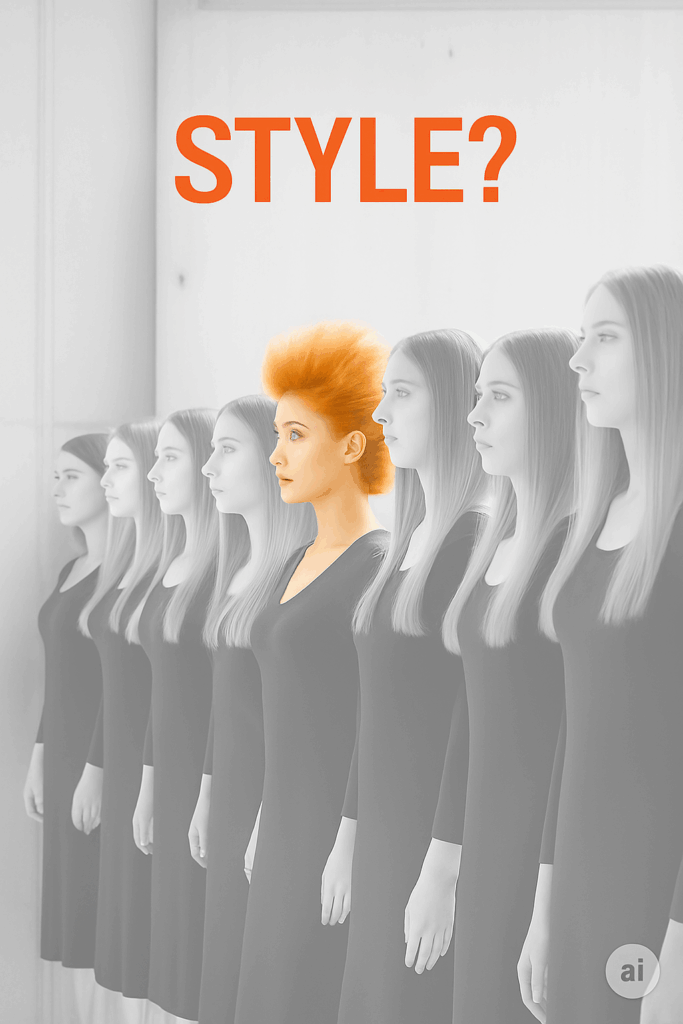
Everyone talks about individuality – but what do you really see in the feeds, at the beach, in everyday life?
Long hair, middle parting – all women copying the same style.
The Kardashian-clone has long since turned into a uniform.
And this style becomes the uni-form.
And yet, what you secretly long for most is to be seen as unique.
When someone says: “Wow, that’s exactly YOU” – that’s your wish.
And you hate it when someone says: “Oh, you’re just like her over there.”
And still, you disguise yourself.
In the Insta feed, at the beach, in everyday life – the same mask, the same silhouette.
Even the poses are copied. You seek out the “Insta-worthy” places everyone knows –
and still you hope to look special?
Coco Chanel once said:
“In order to be irreplaceable, one must always be different.”
Coco was far more than a fashion designer – she was a pioneer.
She freed women from corsets and gave them new freedom through simple elegance.
She didn’t just create fashion – she liberated it.
And with that, she made room for all who dare to be real.
But here lies the irony of fashion history:
What once symbolized liberation has itself become a uniform.
The Chanel suit, the bag, the little black dress – symbols of rebellion and pioneering spirit –
are now mass commodities on runways and in feeds.
That’s how quickly uniqueness flips into imitation.
And again, the question arises:
Where does the mask end – and where does the real begin?
Courage begins where the copy ends.
But – from an early age we learn: Whoever dares to be visibly different risks being laughed at, excluded, or bullied. And that leaves a mark.
The need for belonging is an ancient instinct – and often stronger than the courage to be unique.
Uniformity offers safety.
Those who adapt make fewer decisions, face less need to justify themselves.
The comfort zone feels easier than the struggle for authenticity.
But what (or who?) gets lost in the process?